
Golden Retriever Puppy Teething
A 3-month-old Golden Retriever puppy is entering one of the most noticeable stages of puppy development: teething. At this age, your puppy may chew almost everything, including shoes, furniture, toys, blankets, and even your hands. This behavior can be frustrating, but it is usually a normal part of growing up.
Understanding golden retriever puppy teething can make this stage much easier. Your puppy is not simply being naughty. Their baby teeth are beginning to loosen, adult teeth are developing underneath the gums, and chewing provides natural relief from discomfort.
This guide explains what happens at three months, the different Golden Retriever puppy teething stages, what symptoms to expect, how to manage chewing and biting, which toys are useful, and when a veterinarian should examine your puppy.
What Happens to a Golden Retriever Puppy at 3 Months?
At around three months old, a Golden Retriever puppy is usually moving from the early puppy stage into an active teething period.
Most puppies are born without visible teeth. Their first baby teeth begin appearing during the first few weeks of life. By about 6–8 weeks, most puppies have their complete set of temporary teeth.
At three months, however, the process starts changing.
The roots of baby teeth begin to weaken as permanent teeth develop. The adult teeth gradually push through the gums and eventually replace the baby teeth.
This means your puppy may:
- Chew more frequently
- Bite toys, furniture, or clothing
- Have sore or sensitive gums
- Drool more than usual
- Leave small blood spots on toys
- Become interested in cold objects
- Have slightly stronger breath odor
- Lose individual baby teeth
- Become temporarily more mouthy
These signs can vary between puppies. Some Golden Retrievers seem uncomfortable during teething, while others continue playing normally.
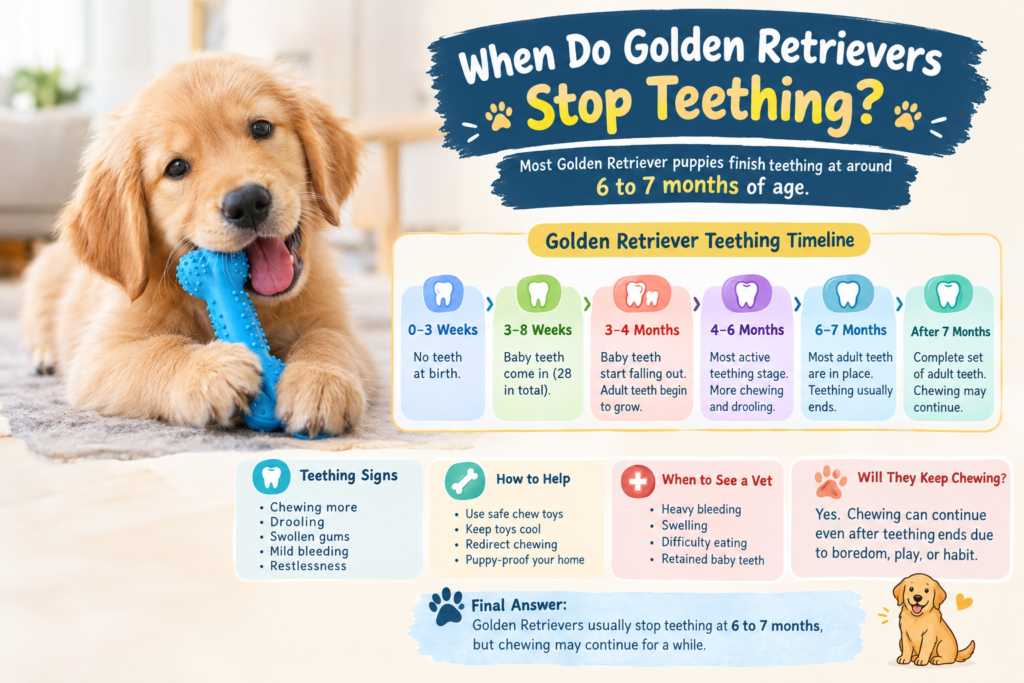
Golden Retriever Puppy Teething Timeline
Knowing the normal timeline helps you understand what your puppy is experiencing.
Birth to 2 Weeks
Newborn Golden Retriever puppies generally have no visible teeth. Their main activities are nursing, sleeping, and staying close to their mother and littermates.
3 to 5 Weeks
Baby teeth begin appearing. These are commonly called deciduous or milk teeth.
The puppy starts becoming more interested in chewing and exploring objects with its mouth.
6 to 8 Weeks
Most puppies have their baby teeth by this stage. A Golden Retriever puppy has approximately 28 deciduous teeth.
These teeth are small and sharp. This is one reason puppy biting can feel surprisingly painful.
Around 3 Months
This is an important transition period.
Your puppy’s permanent teeth are developing, and the roots of some baby teeth begin being resorbed. The puppy may start chewing much more intensely.
This is where golden retriever puppy teething becomes especially noticeable to many owners.
4 to 5 Months
Permanent teeth become increasingly visible. Baby teeth continue falling out as adult teeth emerge.
Chewing can become intense during this period.
6 to 7 Months
Most puppies have most or all of their permanent teeth by this time. The typical adult dog has 42 permanent teeth.
However, individual development can vary, so there is no need to panic if the timeline is slightly different.

Golden Retriever Teething Stages
Understanding the Golden Retriever teething stages makes it easier to distinguish normal development from a problem.
Stage 1: Baby Teeth Appear
The first stage occurs during early puppyhood.
Small, sharp teeth begin emerging through the gums. Puppies learn to use these teeth while eating and exploring their surroundings.
At this point, chewing is already an important behavior.
Stage 2: The Transition Begins
Around three months, your Golden Retriever begins moving toward permanent teeth.
The adult teeth developing underneath the baby teeth gradually cause the temporary teeth to loosen.
Your puppy may chew more because pressure against the gums can feel soothing.
Stage 3: Baby Teeth Fall Out
You may find a tiny tooth on the floor, inside a toy, or in your puppy’s bedding.
Don’t worry if you never find one.
Puppies frequently swallow their loose baby teeth while eating or playing. In most cases, this is harmless.
Small amounts of blood can also appear when a tooth falls out.
Stage 4: Adult Teeth Emerge
Permanent teeth begin pushing through the gums.
This can produce increased chewing, drooling, gum sensitivity, and changes in appetite.
Your puppy may prefer softer food or chew toys temporarily if the gums are uncomfortable.
Stage 5: Adult Mouth Develops
By roughly six to seven months, many Golden Retrievers have their adult teeth.
The intense teething period gradually decreases, although chewing itself remains a normal behavior for young dogs.
This distinction is important.
Teething eventually ends, but chewing does not necessarily end.
A six-month-old puppy may still chew because chewing is entertaining, mentally stimulating, and part of normal canine behavior.
How to Tell If Your 3-Month-Old Golden Retriever Is Teething
The easiest way to recognize teething is to look for a combination of physical and behavioral changes.
Increased Chewing
Your puppy may suddenly become interested in objects that previously seemed boring.
Furniture legs, cardboard, shoes, rugs, and wooden objects can become attractive targets.
More Puppy Biting
Teething can increase mouthiness, but not every bite is caused by painful gums.
Puppies also bite because they are playing, exploring, communicating, and learning bite control.
Therefore, simply giving a teething toy may not completely solve biting.
You also need to teach your puppy what is appropriate to put in its mouth.
Sore or Red Gums
The gums can look slightly irritated while teeth are moving through them.
Mild redness can occur during normal teething.
However, significant swelling, pus, severe bleeding, or a strong unpleasant odor should not automatically be blamed on teething.
Drooling
Some puppies drool more during teething.
If drooling suddenly becomes excessive or is accompanied by difficulty swallowing, facial swelling, vomiting, weakness, or other concerning symptoms, contact your veterinarian.
Small Blood Spots
A small amount of blood on a chew toy can occur when a baby tooth falls out.
Large amounts of blood or persistent bleeding are different and require veterinary attention.
Temporary Bad Breath
A mild change in breath can occur while the mouth is changing.
Persistent foul breath, swollen gums, discharge, or obvious pain deserves closer attention.
Why Does My Golden Retriever Chew Everything at 3 Months?
Chewing has several purposes for a puppy.
First, it can provide relief when the gums feel uncomfortable.
Second, chewing is a way for puppies to investigate their environment. Dogs naturally use their mouths to explore objects.
Third, chewing provides mental stimulation.
This explains why simply telling a puppy, “No,” often doesn’t work.
The puppy still has the biological need to chew.
The better approach is to redirect the behavior.
For example, if your Golden Retriever starts chewing a table leg, calmly interrupt the behavior and offer an appropriate chew toy.
When the puppy chooses the toy, praise them.
Over time, your puppy learns:
Furniture = not allowed.
My chew toy = allowed.
Best Teething Toys for a Golden Retriever Puppy
A good teething toy should be appropriate for your puppy’s age, size, chewing style, and developmental stage.
Look for toys designed specifically for puppies.
Useful options may include:
- Durable rubber puppy toys
- Puppy-safe food-stuffed toys
- Flexible chew toys
- Appropriate puppy teething rings
- Supervised frozen treats or food-filled toys
- Soft rubber toys that provide gentle gum pressure
The goal is not to find the hardest toy possible.
Extremely hard objects can potentially damage teeth.
Avoid giving your puppy extremely hard items such as rocks, antlers, bones of inappropriate hardness, or other objects that could fracture teeth.
A useful rule is to choose products made specifically for puppies and supervise their use.
If a toy becomes damaged or pieces begin breaking off, remove it.
Can I Give My 3-Month-Old Golden Retriever a Frozen Toy?
Cold can provide temporary soothing for irritated gums.
A puppy-safe rubber toy can sometimes be chilled or filled with an appropriate food and frozen, depending on the product’s instructions.
The important point is to avoid turning everything into an extremely hard frozen object.
You want gentle cooling and chewing—not something that becomes so hard that it can damage developing teeth.
Always supervise your puppy with a new teething product.
How to Stop a Golden Retriever Puppy From Biting Hands
Teething and puppy biting often occur together, but they should be handled separately.
If your puppy bites your hand during play, avoid turning the interaction into a wrestling match.
Instead:
- Stop moving your hand.
- Calmly end the game for a moment.
- Offer an appropriate toy.
- Resume play when your puppy engages with the toy.
- Praise calm interaction.
Everyone in the household should follow the same rules.
If one person allows hand biting as a game while another person discourages it, the puppy receives mixed signals.
Don’t Punish Normal Teething
Physical punishment is not an appropriate way to handle puppy biting.
Yelling, hitting, or forcefully closing the puppy’s mouth can create fear and may damage your relationship with your dog.
Instead, teach an alternative behavior.
For example, ask your puppy to sit before starting a game. This teaches your puppy that calm behavior earns attention.
Golden Retriever Puppy Teething and Crate Training
Teething can also affect crate training.
A puppy left alone with nothing appropriate to chew may start chewing bedding, crate parts, or other objects.
Provide a safe, puppy-appropriate chew or food-stuffed toy that suits your individual puppy and your veterinarian’s recommendations.
However, don’t fill the crate with numerous loose objects.
The crate should remain a safe resting area rather than becoming a storage box for toys.
If your puppy is repeatedly destroying crate bedding or swallowing pieces, remove the unsafe item and discuss appropriate alternatives with your veterinarian or trainer.
Feeding a 3-Month-Old Golden Retriever During Teething
Teething does not normally mean that a healthy puppy needs to stop eating regular puppy food.
A three-month-old Golden Retriever should generally remain on an appropriate puppy diet designed for growth.
Because Golden Retrievers are a large breed, nutritional balance matters.
A puppy food formulated for large-breed growth can help provide controlled levels of calories and nutrients.
Avoid making major dietary changes simply because your puppy is teething unless there is a specific reason.
If your puppy seems uncomfortable eating, check whether the problem is actually the mouth.
Watch for:
- Dropping food
- Crying while chewing
- Refusing food
- Difficulty picking up food
- Excessive pawing at the mouth
- Swelling
- Persistent bleeding
A puppy that refuses food because of significant oral discomfort should be evaluated by a veterinarian.
For broader nutrition questions, feeding schedules, portions, and body-condition monitoring should be considered separately from the teething process.
What Should You Do When a Baby Tooth Does Not Fall Out?
Sometimes a baby tooth remains in place while the permanent tooth begins emerging.
This is called a retained deciduous tooth.
It can be particularly important when a permanent tooth and baby tooth appear to occupy the same area.
A retained tooth can contribute to abnormal tooth positioning and food accumulation around the teeth.
Do not pull a stubborn puppy tooth yourself.
If you notice an adult tooth coming in while the baby tooth remains firmly attached, ask your veterinarian to examine the mouth.
Early attention can be useful because the permanent tooth is still developing its final position.
How to Puppy-Proof Your Home During Teething
A three-month-old Golden Retriever can be surprisingly creative.
If something is reachable, assume your puppy may investigate it.
Before leaving your puppy unsupervised, remove:
- Shoes
- Children’s toys
- Electrical cords
- Small plastic objects
- Socks
- Remote controls
- Trash
- Toxic plants
- Cleaning products
- Small objects that can be swallowed
Use baby gates or a puppy-safe area when necessary.
Puppy-proofing is not simply about protecting your furniture. It can prevent choking, intestinal obstruction, electrical injuries, and poisoning.
This is one of the most overlooked parts of managing golden retriever puppy teething.
A Simple Daily Teething Routine
A consistent routine can make this stage much easier.
Morning
Give your puppy an appropriate opportunity to chew after waking and going outside.
Short training sessions can also provide mental stimulation.
During Play
Keep an appropriate chew toy nearby.
If your puppy begins biting hands or furniture, redirect immediately.
During Rest
Provide a calm sleeping environment.
Puppies need substantial sleep, and an overtired puppy may become much more mouthy and difficult to manage.
During Supervised Chewing
Check the toy regularly.
Look for cracks, missing pieces, sharp edges, or excessive wear.
Before Bed
Give your puppy an appropriate final activity and then allow them to settle.
Consistency is more effective than repeatedly correcting the same behavior.
Common Mistakes During Golden Retriever Puppy Teething
Giving Extremely Hard Chews
Hard does not automatically mean safe.
Some extremely hard objects can damage teeth.
Allowing Hand Biting Sometimes
If biting is acceptable during one game but forbidden during another, your puppy cannot understand the rule clearly.
Punishing Chewing
Chewing is normal.
Your responsibility is to teach your puppy where chewing is appropriate.
Leaving Dangerous Objects Accessible
A teething puppy can turn an ordinary household object into a health emergency.
Assuming Every Mouth Problem Is Teething
This is an important mistake.
Teething can explain many normal changes, but it should not be used to dismiss severe swelling, persistent bleeding, significant pain, pus, facial swelling, or refusal to eat.
Changing Food Unnecessarily
Teething alone usually isn’t a reason to repeatedly change a puppy’s diet.
Frequent food changes can create digestive problems.
When Should You Call a Veterinarian?
Most teething signs are mild, but certain symptoms deserve professional attention.
Contact your veterinarian if your puppy has:
- Significant or persistent mouth bleeding
- Severe facial swelling
- Pus around a tooth
- Severe or worsening pain
- Persistent refusal to eat
- Difficulty swallowing
- A broken tooth
- A retained baby tooth
- A permanent tooth growing in an abnormal position
- Extreme lethargy or other illness signs
- A foreign object stuck in the mouth
If you’re unsure whether something is normal teething, it is safer to ask your veterinarian rather than assuming.
Puppy dental examinations are also useful during routine veterinary visits because the veterinarian can monitor how the permanent teeth are developing.
How Long Does Golden Retriever Puppy Teething Last?
The most active teething period usually occurs during the first several months of life as permanent teeth replace baby teeth.
Many puppies have most of their adult teeth by around six to seven months, although individual development can vary.
The important thing to remember is that teething and chewing are not the same thing.
Your Golden Retriever may finish teething but continue chewing well beyond the teething period.
That is normal.
The goal is therefore not to eliminate chewing completely. Instead, teach your dog which things are appropriate to chew.
What Happens After Teething?
Once your Golden Retriever has its adult teeth, your attention can gradually shift from managing teething discomfort to long-term dental care.
This includes:
- Regular dental checks
- Tooth brushing
- Appropriate dental products
- Safe chewing habits
- Monitoring gum health
- Routine veterinary examinations
Introducing gentle tooth brushing while your dog is young can make future dental care much easier.
Start slowly.
Let your puppy become comfortable with your finger near the mouth before introducing a puppy-safe toothbrush and veterinary-approved toothpaste.
Never use human toothpaste unless your veterinarian specifically tells you it is safe.
Frequently Asked Questions
Is 3 months too early for a Golden Retriever to start teething?
No. Three months is a common age for a Golden Retriever to enter the transition from baby teeth toward permanent teeth. Increased chewing and mouthiness can occur during this period.
Should I be worried if I find blood on my puppy’s chew toy?
A small amount of blood can occur when a baby tooth becomes loose or falls out. Persistent or heavy bleeding is not something to simply assume is normal teething and should be discussed with a veterinarian.
Does teething make Golden Retrievers aggressive?
Teething discomfort can make a puppy more irritable or mouthy, but normal puppy biting should not automatically be interpreted as aggression. Play, exploration, excitement, and lack of bite inhibition can all contribute to biting.
Why is my 3-month-old Golden Retriever suddenly chewing furniture?
The developing adult teeth and sensitive gums can increase the desire to chew. Restrict access to furniture, provide appropriate alternatives, and consistently reward your puppy for choosing the correct object.
Should I pull out my Golden Retriever puppy’s loose tooth?
No. Normally, you should allow baby teeth to fall out naturally. If a baby tooth remains while an adult tooth is emerging, have your veterinarian check it rather than attempting to remove it yourself.
Can I give my puppy ice cubes for teething?
Cold can provide temporary relief, but very hard objects may pose a dental risk. Puppy-safe chilled toys or appropriately prepared frozen food toys can be better options when used according to product guidance and under supervision.
Why does my puppy still bite after getting teething toys?
Teething toys address the need to chew, but puppy biting also comes from play, excitement, exploration, and developing bite inhibition. Training and consistent redirection are therefore still necessary.
Do Golden Retrievers stop chewing after teething?
Not necessarily. The physical discomfort of teething eventually ends, but chewing remains a normal canine behavior. Continue teaching your Golden Retriever which objects are appropriate to chew.
What is the most important thing to remember during the Golden Retriever teething stages?
The most important principle is to manage rather than simply punish the behavior. Give your puppy safe chewing options, puppy-proof the environment, teach appropriate behavior, and monitor the mouth for signs that go beyond normal teething.
Final Thoughts
A 3-month-old Golden Retriever is entering an important developmental period. The combination of changing teeth, sensitive gums, curiosity, and increasing independence can make this stage challenging for owners.
Understanding Golden Retriever puppy teething helps you respond to chewing and biting more effectively. Your puppy needs safe opportunities to chew, consistent training, appropriate nutrition, supervision, and a puppy-proof environment.
The Golden Retriever teething stages generally progress from baby teeth appearing to baby teeth loosening and falling out to permanent teeth emerging. During this period, mild gum irritation, increased chewing, occasional small blood spots, and mouthiness can be normal.
At the same time, don’t assume every dental problem is simply teething. Persistent bleeding, severe pain, swelling, pus, difficulty eating, broken teeth, or retained baby teeth deserve veterinary attention.
Most importantly, remember that this stage is temporary. Your puppy is learning how to use its mouth, explore the world, and become an adult dog. With safe chew toys, positive training, consistent boundaries, and good dental habits, you can turn a difficult teething period into an important part of raising a healthy Golden Retriever.