
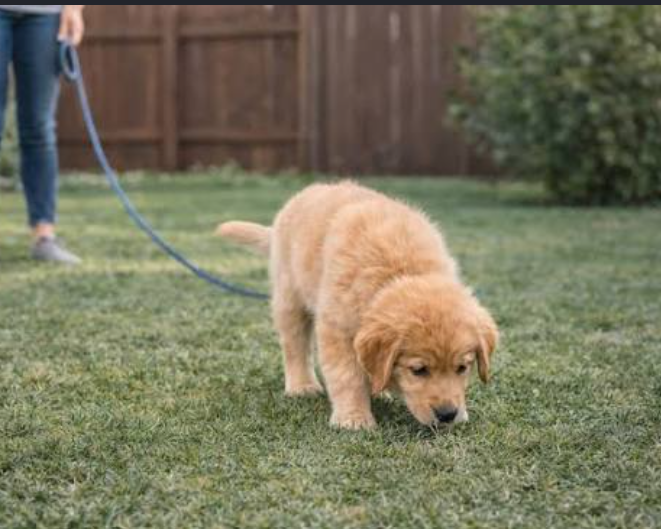
Golden retriever potty training indoor can be a good option for people who live in apartments, have limited outdoor access, or need a safe potty solution during bad weather. With the right method, you can teach your puppy to use a specific indoor potty area instead of having accidents around the house.
Bringing a Golden Retriever puppy home is exciting, but potty training can become one of the first big challenges for a new owner. Puppies do not automatically know where they should pee or poop. They need clear instructions, a regular routine, and plenty of patience.
In this guide, you will learn how to potty train a golden retriever indoors, how long the process usually takes, how to handle nighttime potty training, and how indoor training compares with outdoor training.
Are Golden Retrievers Easy to Potty Train?
Yes, Golden Retrievers are generally easy to potty train. They are intelligent, eager to please, and usually respond well to rewards and praise.
However, puppies still need time to develop bladder control. Therefore, even an intelligent Golden Retriever can have accidents during the first few weeks.
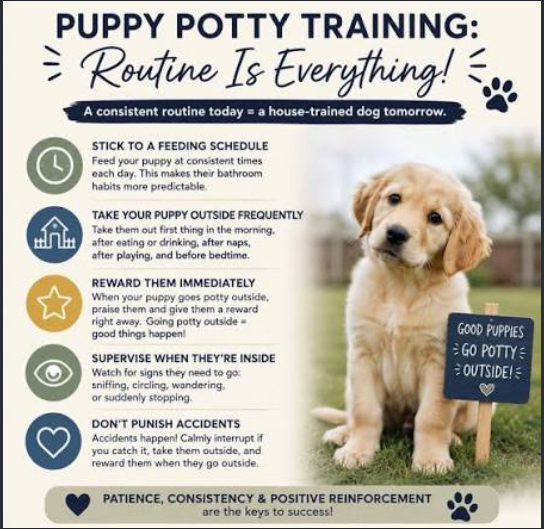
For successful golden retriever potty training indoor, focus on three things: a consistent schedule, close supervision, and immediate rewards.
When your puppy uses the correct potty area, reward them immediately. As a result, your puppy will begin to understand that using that location brings a positive result.
At What Age Should a Golden Retriever Be Potty Trained?
You can start potty training your Golden Retriever puppy as soon as you bring them home. Most puppies go to their new homes at around 8 weeks old.
So, at what age should a golden retriever be potty trained? The answer is simple: start training at about 8 weeks, but do not expect perfect control immediately.
Young puppies have small bladders and cannot hold urine for long periods. Therefore, they need frequent potty opportunities.
At first, take your puppy to the potty area after:
- Waking up
- Eating
- Drinking
- Playing
- Taking a nap
- Excitement or active play
- Before bedtime
As your puppy grows, increase the time between potty breaks.
Starting early makes golden retriever potty training indoor easier because your puppy learns the correct habit before developing bad habits.

What Do You Need for Indoor Potty Training?
Before beginning golden retriever potty training indoor, prepare everything you need.
You can use:
- Puppy pee pads
- Washable potty pads
- An indoor dog toilet
- An indoor grass potty area
- Puppy treats
- A crate
- A puppy playpen
- Pet-safe cleaning products
- Paper towels
Choose one potty area and keep it there.
For example, you can place the potty pad in a bathroom, laundry area, or another easy-to-clean location. However, keep it away from your puppy’s food and sleeping area.
A consistent location makes golden retriever potty training indoor much easier because your puppy learns to associate one place with going potty.
How to Potty Train a Golden Retriever Indoors
Learning how to potty train a golden retriever indoors becomes easier when you follow the same steps every day.
1. Choose One Potty Location
First, select one permanent indoor potty location.
Do not move the pee pad from room to room. Your puppy needs a clear and predictable place.
If you move the pad frequently, your puppy may think that different parts of the house are acceptable potty areas.
Therefore, choose the location carefully before starting golden retriever potty training indoor.
2. Create a Regular Schedule
Next, create a daily potty schedule.
Young Golden Retriever puppies usually need frequent potty breaks. Take your puppy to the indoor potty area regularly rather than waiting for an accident.
A simple routine can look like this:
Morning: Take the puppy to the potty area immediately after waking.
After breakfast: Give the puppy another potty opportunity.
After play: Take the puppy to the potty area again.
After naps: Take the puppy immediately to the potty area.
Before bedtime: Give the puppy one final potty opportunity.
This routine makes golden retriever potty training indoor predictable for your puppy.
3. Watch Your Puppy Closely
Supervision plays a major role in golden retriever potty training indoor.
Watch your puppy when they walk around the house. Puppies often show signs that they need to pee or poop.
Look for:
- Sniffing the floor
- Walking in circles
- Restlessness
- Suddenly stopping during play
- Going toward a corner
- Scratching the floor
- Whining
- Trying to leave the room
When you see these signs, immediately take your puppy to the indoor potty area.
4. Use a Potty Command
Choose a simple command such as “Go potty.”
Say the command every time you take your puppy to the potty area.
Keep your voice calm and consistent. Eventually, your puppy can learn to connect the command with the potty behavior.
This simple technique can improve golden retriever potty training indoor because your puppy learns both the location and the verbal cue.
5. Reward Your Puppy Immediately
Rewarding your puppy is one of the most important parts of golden retriever potty training indoor.
When your puppy finishes peeing or pooping in the correct place, immediately give them a small treat and praise them.
Do not wait several minutes before giving the reward. Your puppy needs to connect the reward with the behavior.
For example, when your puppy finishes, say “Good job!” and give the treat.
Positive reinforcement encourages your puppy to repeat the behavior.
Golden Retriever Potty Training at Night Indoors
Nighttime can become difficult because young puppies may need to pee during the night.
Golden retriever potty training at night indoors can make nighttime easier, especially for people who live in apartments or cannot safely take a young puppy outside at night.
Place the indoor potty area somewhere your puppy can reach easily.
Before bedtime, take your puppy to the potty area. Then put the puppy back in their sleeping area.
If your puppy wakes up during the night and needs to go, calmly take them to the potty area.
Keep nighttime potty trips boring. Do not play, run around, or give your puppy lots of attention.
After they finish, return them to bed.
As your puppy grows, they should gradually hold their bladder for longer periods. You can then reduce nighttime potty trips.
Good golden retriever potty training indoor also means teaching your puppy that nighttime is for sleeping, not playing.
How Long to Potty Train a Golden Retriever?
Many owners ask, how long to potty train a golden retriever?
There is no exact number of days that works for every puppy.
Some puppies learn the basic routine within a few weeks. Others need several months before they become consistently reliable.
Age, bladder control, routine, supervision, and consistency all affect the training time.
When you ask how long to potty train a golden retriever, remember that occasional accidents are normal during puppyhood.
Instead of focusing only on speed, watch for progress.
For example, your puppy may:
- Have fewer accidents.
- Use the potty area more often.
- Start walking toward the potty area.
- Hold urine for longer.
- Give you signals when they need to go.
These are all signs that golden retriever potty training indoor is working.
How Long to Potty Train a Golden Retriever Puppy Indoors?
If you are wondering how long to potty train a golden retriever puppy indoors, expect the process to take several weeks to a few months.
A very young puppy may need more time because they have limited bladder control.
For example, an 8-week-old puppy cannot be expected to hold urine as long as a 5-month-old puppy.
Therefore, how long to potty train a golden retriever puppy indoors depends partly on the puppy’s age.
Your training routine also matters. If you take your puppy to the correct location regularly and reward good behavior, the puppy can learn faster.
So, when asking how long to potty train golden retriever puppy indoors, focus on steady improvement instead of expecting a specific deadline.
How Long to Potty Train Golden Retriever Indoors?
The answer to how long to potty train golden retriever indoors varies from puppy to puppy.
Some Golden Retrievers become fairly reliable after several weeks, while others need more time.
If your puppy continues having accidents after several weeks, do not assume that they are stubborn.
Instead, check your routine.
Are you taking the puppy to the potty area often enough?
Are you watching them closely?
Do you reward them immediately?
Do you clean accidents properly?
These questions can help you improve golden retriever potty training indoor.
How to Potty Train a Golden Retriever in an Apartment
Many owners search for how to potty train a golden retriever in an apartment because getting outside quickly can be difficult.
Fortunately, you can create an indoor potty area in a small apartment.
First, choose an easy-to-clean location.
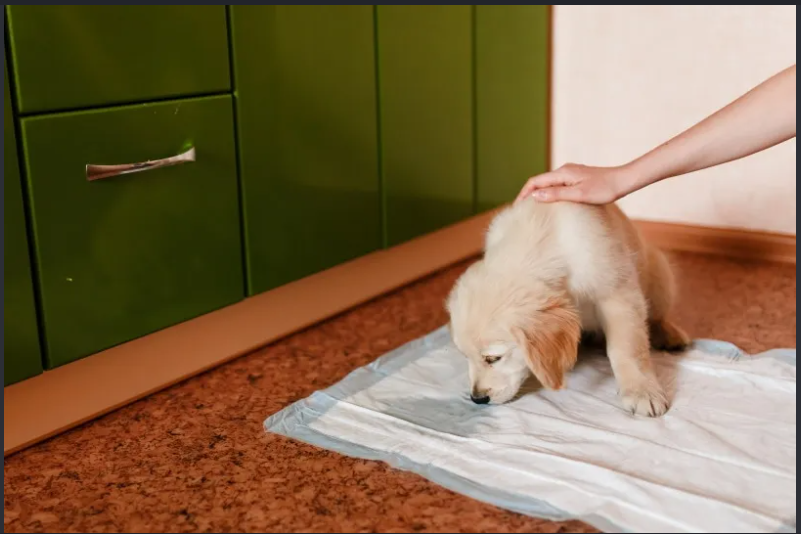
Next, place a pee pad, washable pad, or indoor grass potty in that location.
Then, limit your puppy’s access to the entire apartment during the early training period.
A puppy playpen can help you create a smaller, controlled area.
When your puppy needs to potty, guide them directly to the designated location.
Once they finish, reward them immediately.
Over time, your puppy will understand the routine.
This makes golden retriever potty training indoor particularly useful for apartment owners.
Apartment Potty Training Tips
If you live in an apartment, follow these simple tips:
- Keep the potty area close to where your puppy spends most of the day.
- Keep the location consistent.
- Clean accidents immediately.
- Supervise your puppy closely.
- Use a crate or playpen when you cannot watch the puppy.
- Reward correct potty behavior.
- Keep nighttime potty trips quiet.
- Slowly increase your puppy’s freedom as they improve.
Most importantly, remain consistent. Golden retriever potty training indoor becomes much easier when the puppy sees the same routine every day.
Indoor vs Outdoor Potty Training
Both indoor and outdoor potty training can work. However, each method has different advantages.
| Feature | Indoor Potty Training | Outdoor Potty Training |
|---|---|---|
| Best for | Apartments and limited outdoor access | Homes with easy outdoor access |
| Convenience | Very convenient | Requires going outside |
| Nighttime | Easier for young puppies | More difficult |
| Bad weather | Not a major problem | Can be challenging |
| Space needed | Small indoor area | Outdoor area |
| Cleaning | Potty area needs regular cleaning | Usually easier to manage |
| Long-term use | Can be temporary or permanent | Common long-term option |
| Puppy access | Easy and quick | Puppy must reach the door/outside |
| Training approach | Uses a fixed indoor location | Uses a fixed outdoor location |
The best choice depends on your lifestyle.
For example, golden retriever potty training indoor can work well in an apartment. On the other hand, outdoor training may be more convenient if you have a safe yard.
How to Prevent Indoor Potty Accidents
Accidents are normal, but you can reduce them with proper management.
First, keep your puppy close to you.
Next, use a crate or playpen when you cannot provide direct supervision.
Also, take your puppy to the potty area after meals, naps, and play.
Most importantly, do not give a young puppy too much freedom too quickly.
If your puppy has access to the entire house, they may choose a hidden corner for pottying.
Instead, slowly increase their freedom as they become more reliable.
This approach supports successful golden retriever potty training indoor.
What Should You Do When Your Puppy Has an Accident?
Do not punish your puppy.
Yelling, hitting, or rubbing your puppy’s face near an accident will not teach the correct behavior. It can also make your puppy afraid of you.
Instead, clean the area thoroughly.
If you catch your puppy during an accident, calmly interrupt them and take them to the correct potty area.
If they finish there, reward them.
Remember, successful golden retriever potty training indoor depends on teaching your puppy what to do rather than simply punishing mistakes.
How to Clean Indoor Potty Accidents
Clean accidents as soon as possible.
Dogs have a strong sense of smell, so they may return to an area that still smells like urine.
Use a pet-safe cleaner designed to remove urine odors.
Do not simply wipe the area with water and assume the smell is gone.
Proper cleaning is an important part of golden retriever potty training indoor because it reduces the chance of repeated accidents.
Should You Use a Crate During Indoor Potty Training?
Yes, a crate can support potty training when you use it correctly.
Dogs usually avoid eliminating where they sleep. Therefore, a properly sized crate can help you manage your puppy’s potty schedule.
However, never use the crate as punishment.
Also, never keep a young puppy inside for longer than they can reasonably hold their bladder.
Use the crate as a safe resting area while continuing regular potty breaks.
When combined with supervision and rewards, crate use can support golden retriever potty training indoor.
When Should You Give Your Puppy More Freedom?
Do not give your puppy full access to your home immediately.
Instead, start with a small, controlled area.
Once your puppy consistently uses the correct potty location, allow access to another part of the home.
If accidents return, reduce the puppy’s freedom again and increase supervision.
Gradually increasing freedom helps golden retriever potty training indoor stay consistent.
How to Move From Indoor to Outdoor Potty Training
Some owners use indoor potty training temporarily and later want their Golden Retriever to potty outside.
You can make this transition gradually.
First, move the indoor potty area closer to the door.
Then, move it closer to the outdoor exit.
Next, begin taking your puppy outside at the same times you previously used the indoor potty area.
Reward your puppy immediately after they potty outside.
Finally, remove the indoor potty area once your puppy consistently uses the outdoor location.
This gradual transition can make golden retriever potty training indoor easier to replace with outdoor training.
Common Indoor Potty Training Mistakes
Changing the Potty Location
Keep the potty area in one place. Frequent changes can confuse your puppy.
Ignoring the Schedule
Do not wait for your puppy to have an accident before taking them to the potty area.
Giving Too Much Freedom
Young puppies need supervision. Give them more freedom only when they become reliable.
Punishing Accidents
Punishment does not teach your puppy where to potty. Instead, reward the behavior you want.
Forgetting Nighttime Potty Breaks
Young puppies may need nighttime potty opportunities. Plan for them during the early stages.
Stopping Training Too Early
Even if your puppy goes several days without an accident, continue the routine.
Consistency is one of the biggest keys to successful golden retriever potty training indoor.
Signs Your Golden Retriever Is Becoming Potty Trained
Your puppy is making good progress when they:
- Have fewer accidents.
- Use the potty area without constant reminders.
- Walk toward the potty area.
- Hold urine for longer periods.
- Give you signals before they need to go.
- Stay dry overnight for longer periods.
- Follow the same potty routine every day.
When you see these signs, you can slowly give your puppy more freedom.
However, continue rewarding good behavior during golden retriever potty training indoor.
Frequently Asked Questions
Are Golden Retrievers easy to potty train?
Yes. Golden Retrievers are intelligent, eager to please, and usually respond well to positive reinforcement. A consistent routine makes potty training easier.
At what age should a Golden Retriever be potty trained?
Start when your puppy comes home, usually around 8 weeks old. However, young puppies need time to develop bladder control, so expect some accidents.
How long to potty train a Golden Retriever?
Many puppies need several weeks to a few months to become reliable. The exact time depends on age, bladder control, routine, and consistency.
How long to potty train a Golden Retriever puppy indoors?
How long to potty train a golden retriever puppy indoors depends on the individual puppy. Many puppies make noticeable progress within a few weeks, but complete reliability can take several months.
How long to potty train Golden Retriever indoors?
How long to potty train golden retriever indoors varies between puppies. A consistent schedule, supervision, and positive rewards can make the process smoother.
How to potty train a Golden Retriever indoors?
Choose one potty area, take your puppy there regularly, watch for potty signals, and reward them immediately when they use the correct location.
How to potty train a Golden Retriever in an apartment?
Create a fixed indoor potty area using a pee pad, washable pad, or indoor grass potty. Keep your puppy supervised and take them there after sleeping, eating, drinking, and playing.
Can a Golden Retriever puppy use pee pads?
Yes. A Golden Retriever puppy can learn to use pee pads. Keep the pad in one location and reward your puppy every time they use it correctly.
Can you potty train a Golden Retriever at night indoors?
Yes. Golden retriever potty training at night indoors can work well for young puppies. Keep the potty area accessible and make nighttime potty trips quiet and quick.
Should I punish my Golden Retriever for potty accidents?
No. Punishment can create fear and confusion. Instead, clean the accident, supervise your puppy more closely, and reward correct potty behavior.
Final Thoughts
Golden retriever potty training indoor does not need to be stressful. Your puppy needs a clear location, a regular schedule, supervision, and positive reinforcement.
Start training early, usually around 8 weeks, but remember that young puppies have limited bladder control. Therefore, accidents can happen even when your puppy is learning correctly.
If you live in an apartment, golden retriever potty training indoor can provide a practical solution. It can also help during nighttime, bad weather, or situations when going outside is difficult.
Most importantly, stay patient and consistent. With daily practice, your Golden Retriever can learn where to potty and become a clean and well-trained member of your family.
Leave a Reply