
Advanced Training For a Golden Retriever
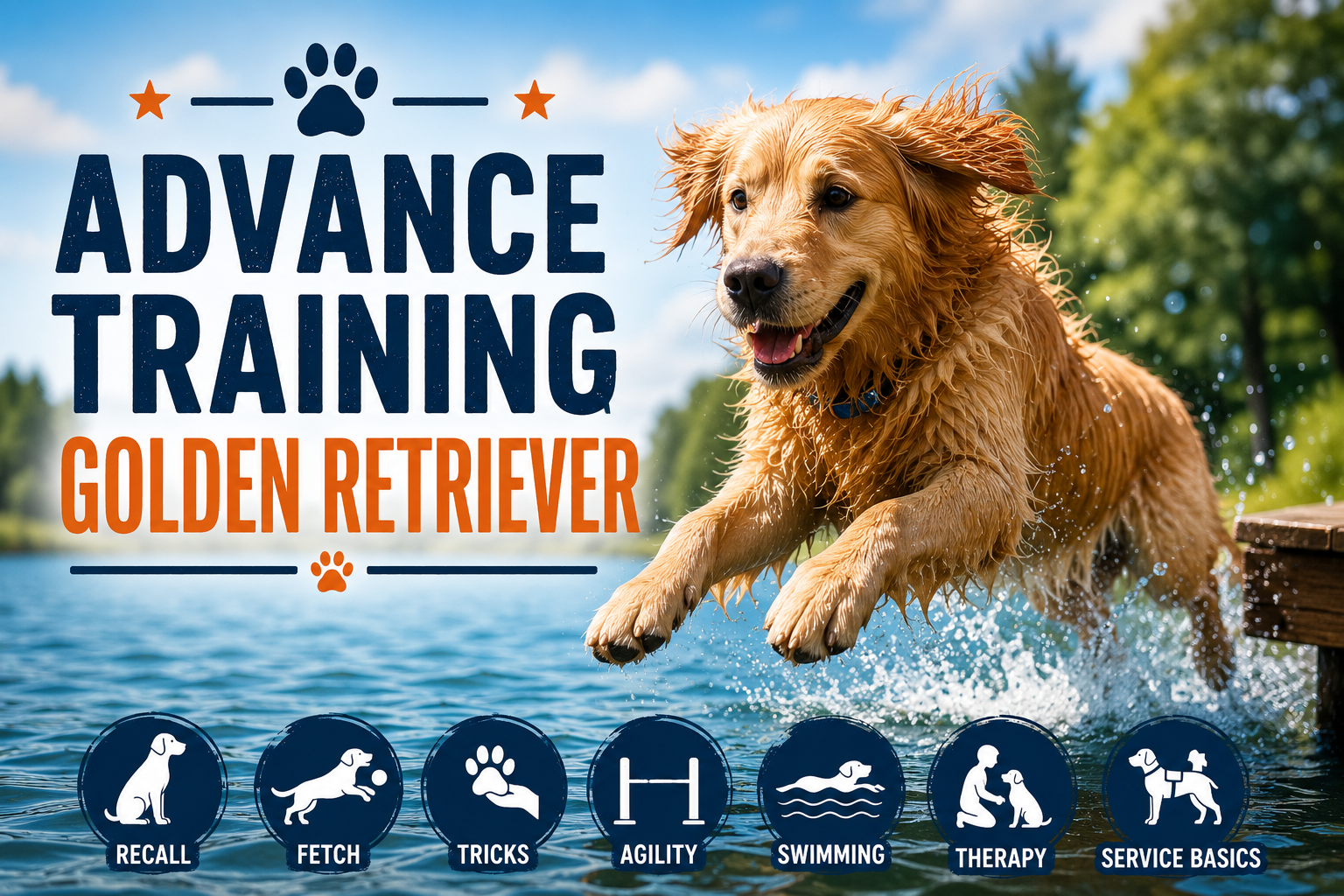
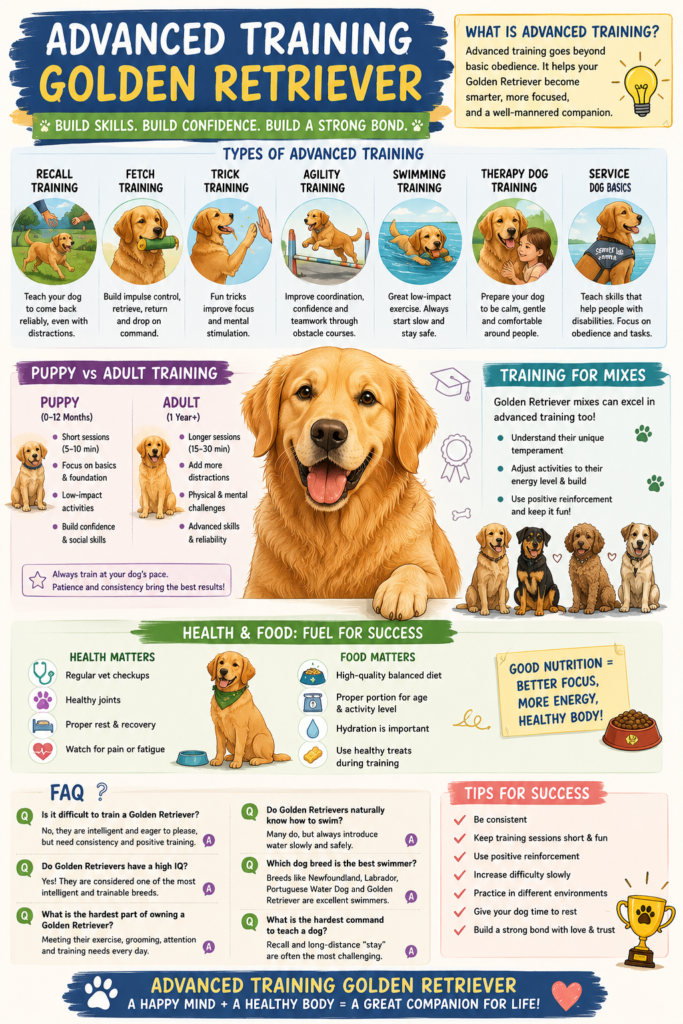
Advanced Training for a Golden Retriever can help your dog become more obedient, confident, focused, and well-mannered. Advanced Training for a Golden Retriever is not only about teaching difficult tricks. It can also include recall, fetch, agility, swimming, therapy work, and basic service dog skills
Golden Retrievers are intelligent, friendly, active, and eager to please. These qualities make them excellent dogs for learning more than basic commands. Once your dog understands commands such as sit, stay, down, and come, you can slowly move toward more challenging activities.
Every Golden Retriever is different. Some dogs learn quickly, while others need more time and repetition. Age, health, food, personality, and previous training can all affect how well a dog performs.
In this guide, we will explain Advanced Training for a Golden Retriever. We will also explain how to train puppies and adult dogs differently, how Golden Retriever mixes can be trained, and how health and nutrition can affect training.
What Is Advanced Training for a Golden Retriever?
Advanced Training for a Golden Retriever means teaching your dog skills beyond simple obedience. Your dog should already understand basic commands before you move to difficult exercises.
Advanced training can include:
- Recall training
- Fetch training
- Trick training
- Agility training
- Swimming training
- Therapy dog training
- Service dog basics
- Impulse control
- Distance commands
- Off-leash obedience
- Scent games
- Public manners
The goal of Advanced Training for a Golden Retriever is not to make your dog perform as many commands as possible. Instead, the goal is to improve communication between you and your dog.
A well-trained Golden Retriever should be able to listen even when there are distractions around.
Why Is Advanced Training Important?
Advanced Training for a Golden Retriever provides both physical and mental activity. Golden Retrievers are active dogs and often enjoy having something to do.
Without enough activity, a bored dog may start looking for its own entertainment. This can lead to chewing, digging, barking, jumping, or stealing household items.
Good Advanced Training for a Golden Retriever can help your dog:
- Improve focus
- Build confidence
- Learn self-control
- Improve obedience
- Use energy positively
- Become easier to manage
- Strengthen the owner-dog relationship
- Learn how to behave around distractions
Training can also make everyday activities easier. A dog with good recall, leash manners, and impulse control is generally easier to handle during walks, trips, and outdoor activities.
Puppy vs Adult Golden Retriever Training
One of the most important parts of Advanced Training for a Golden Retriever is understanding that puppies and adults should not be trained in exactly the same way.
A puppy may have lots of energy but still have developing bones and joints. An adult Golden Retriever can usually handle more physical activity if the dog is healthy.
Advanced Training for Puppies
Puppies can begin learning advanced concepts, but physical exercises should be gentle.
A puppy can practice:
- Name recognition
- Short recalls
- Gentle fetch
- Simple tricks
- Touch
- Leave it
- Drop it
- Short stays
- Walking around obstacles
- Focus exercises
Keep puppy training sessions short and fun.
Avoid repeated jumping, high-impact agility, long-distance running, and other activities that place unnecessary stress on developing joints.
Advanced Training for Adult Golden Retrievers
Healthy adult dogs can usually handle more difficult activities.
Adult training may include:
- Longer recalls
- Advanced fetch
- Agility
- Swimming
- Difficult tricks
- Therapy dog preparation
- Service dog foundation skills
- Distance obedience
The exact amount of exercise should depend on the individual dog.
1. Recall Training
A strong recall is one of the most useful skills in Advanced Training for a Golden Retriever.
Recall means teaching your dog to come back to you when called. A reliable recall can be extremely useful when you are outdoors.
Start training in a quiet and safe place.
Say your dog’s name and then use a word such as “come.” When your dog comes to you, immediately give praise and a reward.
Start with a short distance.
Once your dog understands the command, slowly increase the distance and add distractions.
Puppy Recall Training
Puppies should practice recall from only a few steps away.
Make coming to you exciting. Use a happy voice and reward your puppy when they arrive.
Never punish your puppy after they come to you, even if they took a long time.
You want your puppy to learn that coming back is always a good thing.
Adult Recall Training
Adult dogs can practice recall over greater distances.
You can use a long training leash in a safe area. Slowly introduce distractions such as people, toys, smells, and other dogs.
Never allow an unreliable dog to run off-leash near roads or other dangerous areas.
2. Fetch Training
Golden Retrievers were developed as retrieving dogs, so many naturally enjoy carrying and bringing objects.
Advanced Training for a Golden Retriever: fetch exercises can turn normal play into structured training.
Instead of simply throwing a ball, teach your dog to:
- Wait.
- Watch the toy.
- Go after it.
- Pick it up.
- Return to you.
- Drop it on command.
This teaches patience and control in addition to retrieving.
Fetch for Puppies
Keep puppy fetch sessions short.
Use suitable toys and avoid encouraging high jumps or sudden sharp turns.
Puppies can learn the basic idea of retrieving without doing intense exercise.
Fetch for Adults
Healthy adult Golden Retrievers can usually play longer games.
However, do not play nonstop for a long period. Repeated running and sudden stops can put stress on muscles and joints.
Give your dog regular breaks and fresh water.
3. Trick Training
Trick training is one of the most enjoyable parts of Advanced Training for a Golden Retriever.
Golden Retrievers often enjoy learning tricks because they like interacting with their owners.
You can teach:
- Shake hands
- High five
- Spin
- Bow
- Roll over
- Crawl
- Touch
- Speak
- Find an object
- Bring a toy
- Put toys away
Start with simple tricks and slowly increase the difficulty.
Use treats, praise, or a favorite toy as a reward.
Trick training is especially useful for dogs that need more mental stimulation but cannot do intense physical exercise.
4. Agility Training
Agility is another exciting part of Advanced Training for a Golden Retriever.
Agility can include:
- Tunnels
- Jumps
- Weave poles
- Ramps
- Platforms
- Cones
- Low obstacles
Agility can improve coordination, confidence, focus, and communication.
However, it should be introduced carefully.
Agility for Puppies
Puppies can learn basic foundation skills.
For example, you can teach a puppy to walk around cones, follow your hand, go through a low tunnel, or step over very low obstacles.
Avoid high jumps and repeated impact while the puppy is still growing.
Agility for Adult Dogs
Healthy adult Golden Retrievers can gradually learn more difficult obstacles.
If you want to compete in agility, working with an experienced trainer is a good idea.
Your dog’s health should always come before performance.
5. Swimming Training
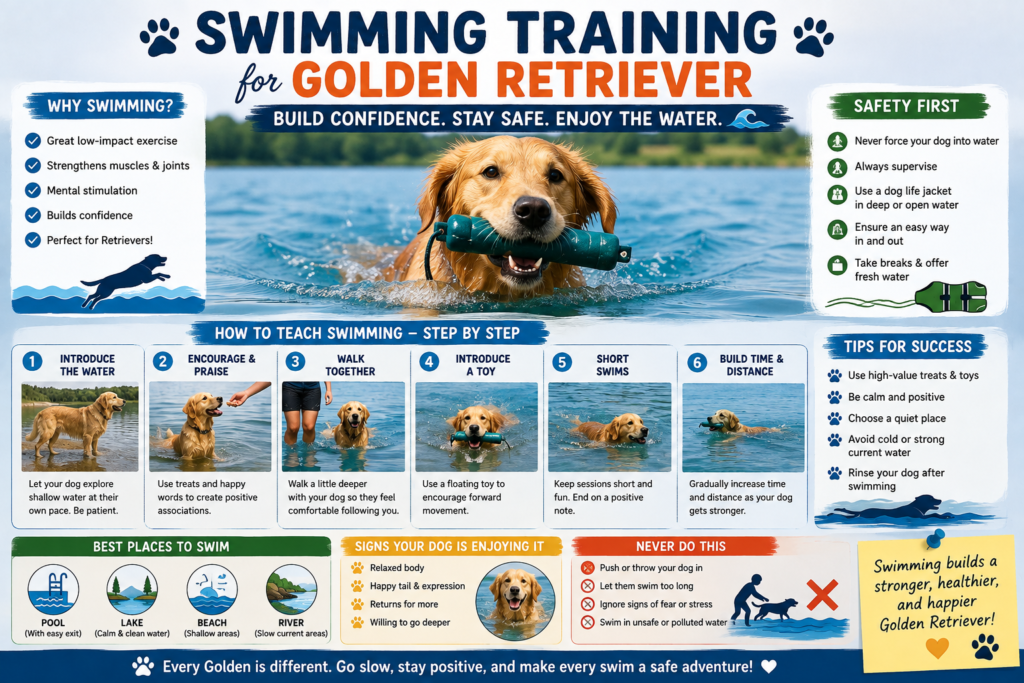
Swimming can be a great part of Advanced Training for a Golden Retriever because many Golden Retrievers enjoy water.
Swimming can provide exercise while putting less impact on the joints than some land-based activities.
However, never assume that your dog is automatically safe in water.
Start in shallow water.
Allow your dog to enter at their own pace.
Never throw a nervous dog into a pool, lake, or river.
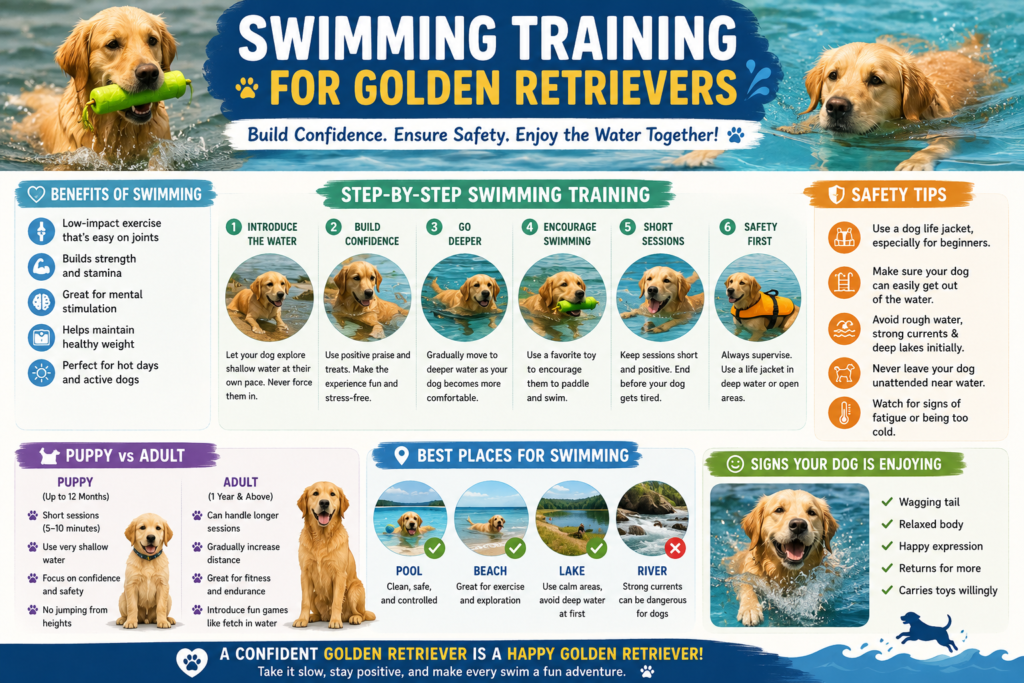
Swimming for Puppies
Puppies can have carefully controlled introductions to water.
Keep sessions short and supervise them closely.
A puppy can become tired quickly.
If you use a pool, make sure the puppy has a safe and easy way to get out.
Swimming for Adults
A healthy adult Golden Retriever may enjoy longer swimming sessions.
Give your dog regular breaks.
Avoid strong currents and unsafe water.
A canine life jacket can provide extra safety when swimming in unfamiliar water.
Do Golden Retrievers Naturally Know How to Swim?
Many people ask, “Do Golden Retrievers naturally know how to swim?”
Many Golden Retrievers have physical traits that can help them swim. Their athletic body and water-resistant coat can make them comfortable in water.
However, not every Golden Retriever automatically knows how to swim safely.
Some dogs are afraid of water. Others may know how to paddle but become tired quickly.
This is why Advanced Training for a Golden Retriever swimming should always be gradual and supervised.
Let your dog learn at their own speed.
Which Dog Breed Is the Best Swimmer?
There is no single breed that is officially the best swimmer for every situation.
Some breeds are especially well known for enjoying water and having strong swimming abilities.
These include:
- Newfoundland
- Labrador Retriever
- Golden Retriever
- Portuguese Water Dog
- Chesapeake Bay Retriever
- Irish Water Spaniel
Newfoundlands are particularly famous for their swimming and water-rescue abilities.
However, swimming ability depends on the individual dog as well as the breed.
6. Therapy Dog Training
Therapy work can be a good goal for a calm and social Golden Retriever.
Advanced Training for a Golden Retriever therapy preparation should focus on calm behavior, obedience, confidence, and good manners.
A therapy dog may meet:
- Elderly people
- Children
- Hospital patients
- People using wheelchairs
- People using walkers
- People with unusual movements
- Other dogs
- Groups of strangers
Your dog should remain calm in these situations.
Important skills include:
- Sit
- Stay
- Down
- Come
- Leave it
- Loose-leash walking
- Calm greetings
- Impulse control
A therapy dog must enjoy interacting with people. A dog that is nervous or uncomfortable around strangers should not be forced into therapy work.
Therapy organizations may also have their own testing and certification requirements.
7. Service Dog Basics
Service dog training is different from normal pet training.
A service dog is trained to perform specific tasks that help a person with a disability.
Golden Retrievers can have qualities that make them suitable for some service roles, but not every Golden Retriever has the right temperament, health, or focus.
Basic Advanced Training for a Golden Retriever service foundations may include:
- Reliable recall
- Loose-leash walking
- Ignoring distractions
- Calm public behavior
- Settling quietly
- Retrieving objects
- Responding to specific cues
- Remaining focused around people
Professional guidance is recommended for actual service dog preparation.
Simply teaching your dog many commands does not automatically make the dog a service dog.
Advanced Training for Golden Retriever Mixes
Advanced Training for a Golden Retriever and skills can also be used with Golden Retriever mixes.
Some common Golden Retriever mixes include:
- Golden Retriever and Labrador mix
- Golden Retriever and German Shepherd mix
- Golden Retriever and Husky mix
- Golden Retriever and Poodle mix
- Golden Retriever and Border Collie mix
Mixes can be intelligent and trainable, but their behavior can be influenced by both parent breeds.
For example, a Golden Retriever-Poodle mix may enjoy mental games and tricks. A Golden Retriever-Husky mix may have more independent behavior. A Golden Retriever-German Shepherd mix may enjoy obedience and working exercises.
The most important thing is to train the individual dog rather than relying only on its breed mix.
How to Adapt Training for Golden Retriever Mixes
Advanced Training for a Golden Retriever should be changed according to the dog’s body and personality.
Consider:
- Size
- Weight
- Energy level
- Age
- Joint health
- Temperament
- Body structure
- Previous injuries
A heavier mix may not be suitable for repeated jumping.
A highly energetic mix may need more mental work.
A nervous mix may need slower introductions to new environments.
Do not assume that every Golden Retriever mix can perform the same physical activities.
How Health Affects Advanced Training
Health is one of the most important parts of Advanced Training for a Golden Retriever.
A dog cannot train safely if it is in pain, overweight, sick, or recovering from an injury.
Before starting demanding activities, pay attention to signs such as:
- Limping
- Stiffness
- Difficulty standing
- Trouble climbing stairs
- Reduced interest in exercise
- Unusual tiredness
- Breathing problems
- Pain during movement
If you notice these signs, stop demanding exercise and speak with your veterinarian.
Golden Retrievers can experience joint and orthopedic problems, so owners should be careful with high-impact activities.
Joint Health and Agility
Agility can be fun, but jumping and sharp turns can put stress on joints.
Puppies should focus on low-impact foundation exercises.
Adult dogs should gradually build strength and skill.
Never increase the height or difficulty of obstacles too quickly.
If your dog starts limping or seems uncomfortable, stop the activity.
Good Advanced Training for a Golden Retriever should improve your dog’s confidence and skills without causing unnecessary physical stress.
How Food Affects Training
Food has a major effect on the advanced training of a Golden Retriever.
Your dog needs a balanced diet to support energy, muscles, bones, and recovery.
A dog’s nutritional needs depend on:
- Age
- Weight
- Activity level
- Body condition
- Health
- Individual needs
Important nutrients include protein, fats, carbohydrates, vitamins, minerals, and water.
Do not choose food only because your dog is doing more training. Choose a complete and balanced diet suitable for your dog’s life stage.
Using Treats During Training
Treats and rewards are useful during advanced training for a Golden Retriever.
However, too many treats can cause unwanted weight gain.
Use small treats rather than large pieces.
You can also use part of your dog’s normal daily food as training rewards when appropriate.
If your dog receives many treats during training, remember to account for those calories.
An overweight dog may have more difficulty with running, agility, jumping, and swimming.
Puppy Food and Training
Puppies need food designed for healthy growth.
This is especially important for Golden Retriever puppies because their bones and joints are still developing.
Good Advanced Training for a Golden Retriever puppy should focus heavily on mental skills rather than difficult physical activities.
A puppy can learn:
- Recall
- Touch
- Leave it
- Drop it
- Wait
- Find it
- Simple tricks
These exercises challenge the brain without putting excessive stress on developing joints.
Adult Golden Retriever Food and Training
Adult Golden Retrievers generally need a balanced adult diet.
A very active adult may have different energy needs from a dog that spends most of the day resting.
However, more Advanced Training for a Golden Retriever does not automatically mean you should give your dog unlimited food.
Watch your dog’s body condition.
If you are unsure about calorie needs or dietary changes, speak with your veterinarian.
Keeping your dog at a healthy weight can make physical activities safer.
Hydration During Training
Water is just as important as food.
Provide fresh water during and after activities, especially in warm weather.
Your dog may need more water after:
- Fetch
- Running
- Agility
- Long walks
- Swimming
- Outdoor training
Take breaks regularly.
Do not wait until your dog becomes extremely thirsty.
Proper hydration is an important part of safe Advanced Training for a Golden Retriever.
Puppy Advanced Training vs Adult Advanced Training
There should be a clear difference between puppy and adult programs.
| Training Area | Puppy | Adult |
|---|---|---|
| Recall | Short distance | Longer distance |
| Fetch | Gentle and short | Longer sessions |
| Tricks | Simple tricks | More complex tricks |
| Agility | Foundation only | More advanced obstacles |
| Swimming | Short and supervised | Longer if healthy |
| Therapy | Socialization foundation | Formal preparation |
| Service skills | Basic obedience | More advanced skills |
| Exercise | Low impact | Higher activity if healthy |
This difference is important because puppies are still developing physically.
Creating a Weekly Training Schedule
A simple weekly advanced training schedule for a Golden Retriever can keep training interesting.
Monday: Recall
Practice coming when called for 10–15 minutes.
Tuesday: Tricks
Teach one new trick or practice two old tricks.
Wednesday: Fetch
Practice retrieving and dropping the toy.
Thursday: Obedience
Work on stay, leave it, heel, and focus.
Friday: Agility Foundation
Use cones, tunnels, or low obstacles.
Saturday: Swimming
If your dog enjoys water and is healthy, practice swimming safely.
Sunday: Rest
Take a relaxed walk and allow your dog to recover.
You do not need to train intensely every day.
Rest is an important part of a good training program.
Signs Your Dog Needs a Break
More advanced training for a Golden Retriever is not always better.
Your dog may need a break if they:
- Lose interest
- Stop responding
- Become unusually tired
- Start moving slowly
- Begin panting heavily
- Refuse to continue
- Become frustrated
- Show stiffness
- Start limping
End the session while your dog is still enjoying the activity whenever possible.
If your dog shows pain or unusual physical symptoms, contact your veterinarian.
Common Advanced Training Mistakes
Owners sometimes make training harder by moving too quickly.
Avoid these mistakes:
Training for Too Long
Long sessions can cause boredom.
Expecting Perfection
Dogs need repetition and practice.
Doing Too Much Physical Exercise
Especially with puppies, more exercise is not always better.
Ignoring Health
Pain can make training difficult.
Using Too Many Treats
Too many calories can lead to weight gain.
Adding Distractions Too Quickly
Build difficulty gradually.
Using Harsh Punishment
Positive reinforcement is generally more useful for teaching new skills.
Forgetting Basic Commands
Advanced skills still depend on good basic obedience.
FAQ’s
Is It Difficult to Train a Golden Retriever?
“Is it difficult to train a Golden Retriever?” Generally, Golden Retrievers are considered relatively easy to train.
They are intelligent, social, and often eager to please.
However, easy to train does not mean that training requires no effort.
Your Golden Retriever still needs:
- Patience
- Consistency
- Repetition
- Clear commands
- Positive reinforcement
- Regular practice
Puppies may have short attention spans, while adolescent dogs may become distracted.
With regular Advanced Training for a Golden Retriever, many dogs can learn an impressive number of skills.
Do Golden Retrievers Have a High IQ?
People often ask, “Do Golden Retrievers have a high IQ?”
Golden Retrievers are widely considered intelligent and highly trainable dogs.
They can learn commands, remember routines, work with people, and solve simple problems.
However, there is no simple human-style IQ score that can accurately measure every dog’s intelligence.
A dog’s ability to learn also depends on motivation, environment, training methods, and personality.
This is one reason Advanced Training for a Golden Retriever can be so enjoyable. They allow the dog to use both its brain and body.
What Is the Hardest Command to Teach a Dog?
“What is the hardest command to teach a dog?” There is no single hardest command for every dog.
Commands that require a dog to ignore strong distractions can be especially difficult.
Recall is one example.
Your dog may be happily smelling the ground or watching another dog. You then ask them to leave the distraction and come back to you.
A reliable stay can also be difficult because your dog must remain in position even when something interesting happens.
That is why Advanced Training for a Golden Retriever should increase difficulty slowly.
What Is the Hardest Part of Owning a Golden Retriever?
“What is the hardest part of owning a Golden Retriever?” For many owners, the biggest challenge is keeping up with exercise, training, grooming, companionship, and mental stimulation.
Young Golden Retrievers can be particularly energetic.
They may require a lot of patience during puppyhood and adolescence.
The effort is worthwhile, but owners should understand that Golden Retrievers require a long-term commitment.
Regular Advanced Training for a Golden Retriever can make daily life easier because your dog learns useful skills and develops better self-control.
Do Golden Retrievers Naturally Know How to Swim?
“Do Golden Retrievers naturally know how to swim?” Many Golden Retrievers have physical characteristics that make swimming easier, but swimming ability is not guaranteed.
Some dogs love water immediately.
Others may feel nervous.
A dog can also know how to paddle but still become tired or have difficulty getting out of a pool.
Therefore, swimming should always be introduced slowly.
Safe swimming practice can become a useful part of Advanced Training for a Golden Retriever when your dog enjoys it and is physically healthy.
Which Dog Breed Is the Best Swimmer?
“Which dog breed is the best swimmer?” There is no single answer.
Newfoundlanders are famous for their swimming and water rescue abilities. Labrador Retrievers, Golden Retrievers, Portuguese Water Dogs, Chesapeake Bay Retrievers, and Irish Water Spaniels are also known for being comfortable around water.
However, individual dogs vary.
A breed known for swimming can still have a dog that dislikes water.
When Should You Get Professional Help?
Professional help can be useful for difficult Advanced Training for a Golden Retriever.
An experienced trainer can help with:
- Competitive agility
- Advanced recall
- Therapy preparation
- Service dog foundations
- Public manners
- Severe distractions
- Complex behavior issues
If your dog shows aggression, severe fear, pain, or sudden behavior changes, speak with a veterinarian or qualified behavior professional.
Final Thoughts
Advanced Training for a Golden Retriever can take your dog far beyond basic obedience. Recall, fetch, tricks, agility, swimming, therapy preparation, and service dog foundations can provide valuable physical and mental challenges.
The most important thing is to choose activities based on your dog’s age, health, personality, and ability.
For puppies, focus on short training sessions, simple tricks, recall, confidence, and gentle foundation exercises. Avoid high-impact activities while their bodies are still developing.
For healthy adult Golden Retrievers, training can become more challenging. They can gradually work on longer recalls, structured fetch, agility, swimming, advanced tricks, and public manners.
Golden Retriever mixes can also enjoy these activities, but their body structure and temperament should be considered. A mix may have different energy levels or physical abilities than a purebred Golden Retriever.
Food and health are also important. A balanced diet, healthy weight, enough water, proper rest, and regular veterinary care can help your dog train safely.
Most importantly, Advanced Training for a Golden Retriever should be enjoyable. Do not focus only on how many commands your dog can perform. Focus on communication, confidence, safety, and the relationship you build together.
With patience, positive training, good nutrition, and the right level of exercise, Advanced Training for a Golden Retriever can help your dog become more focused, confident, active, and well-behaved.
Remember that every dog learns at a different speed. Keep sessions short, reward good behavior, increase difficulty slowly, and give your Golden Retriever plenty of time to rest.
When done correctly, Advanced Training for a Golden Retriever is not just about creating an obedient dog. It is about giving your Golden Retriever useful skills, mental stimulation, confidence, and a more active and enjoyable life.
A safe training plan depends on matching activities to your dog’s age and health, so compare puppy and adult Golden Retriever training limits before increasing exercise or difficulty.
Leave a Reply